PHYSICS BYTES
CBSE CLASS 12 PHYSICS BOARD EXAM 2026
Official Question Paper & Solutions | Set 2 | Q.P. Code 55/2/2
Time Allowed: 3 Hours
Maximum Marks: 70
GENERAL INSTRUCTIONS:
- There are 33 questions in all. All questions are compulsory.
- This question paper has five sections: Section A, Section B, Section C, Section D and Section E.
- Section A contains 16 questions of 1 mark each.
- Section B contains 5 questions of 2 marks each.
- Section C contains 7 questions of 3 marks each.
- Section D contains 2 case study-based questions of 4 marks each.
- Section E contains 3 long answer questions of 5 marks each.
- There is no overall choice. However, internal choices have been provided in some questions.
SECTION A
(1 Mark Each)
1.
Three point charges $+q$, -2q and $+q$ are placed along x-axis at points $x=-1$ m, $x=0$ m and $x=2$ m respectively. The potential energy of the system is
(A) $-\frac{q^{2}}{\pi\epsilon_{0}}$
(B) $-\frac{2q^{2}}{3\pi\epsilon_{0}}$
(C) $\frac{q^{2}}{4\pi\epsilon_{0}}$
(D) $\frac{-5q^{2}}{4\pi\epsilon_{0}}$
[1]
2.
A photosensitive surface is illuminated by radiations of wavelength $\lambda_{1}$, $\lambda_{2}$ $(\gt\lambda_{1})$ and $\lambda_{3}$ one by one and photoemission is observed in each case. $\lambda_{1}$, $\lambda_{2}$ lies in UV range and $\lambda_{3}$ in visible range. If $V_{1}$, $V_{2}$ and $V_{3}$ are stopping potential in these cases respectively, then
(A) $V_{1}=V_{2}=V_{3}$
(B) $V_{2}>V_{1}>V_{3}$
(C) $V_{1}>V_{2}>V_{3}$
(D) $V_{3}>V_{1}>V_{2}$
[1]
3.
In Bohr model of hydrogen atom, the value of potential energy of an electron in $n^{th}$ orbit varies with 'n' as
(A) $\frac{1}{n^{2}}$
(B) $\frac{1}{n}$
(C) n
(D) $n^{2}$
[1]
4.
Two metal spheres of radii $r_{1}$ and $r_{2}(\gtr_{1})$ having charges $q_{1}$ and $q_{2}$ respectively kept in air, are brought in contact. Which of the following statements is not correct?
(A) The total charge of the two spheres is conserved.
(B) Both spheres attain the same potential.
(C) The final potential of the system equals $\frac{1}{4\pi\epsilon_{0}}\frac{(q_{1}+q_{2})}{(r_{1}+r_{2})}$
(D) The final potential of the system equals $\frac{1}{4\pi\epsilon_{0}}\frac{(q_{1}+q_{2})(r_{1}+r_{2})}{r_{1}r_{2}}$
[1]
5.
In Bohr model of hydrogen atom, an electron makes a transition from $n=4$ state to $n=1$ state and a photon of frequency v is emitted. The frequency of photon emitted when an electron makes a transition from $n=4$ state to $n=2$ state in the same model is
(A) $\frac{v}{3}$
(B) $\frac{v}{4}$
(C) $\frac{v}{5}$
(D) $\frac{v}{6}$
[1]
6.
Figure shows a magnet dropped through a small loop with a small cut. Which of the following statements is correct?
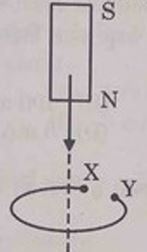
(A) The speed of the falling magnet increases as it approaches the loop and starts decreasing as it crosses the loop.
(B) Acceleration of magnet increases as it approaches the loop and starts decreasing as it crosses the loop.
(C) Speed of magnet remains uniform as it moves through the loop.
(D) Acceleration of the magnet remains uniform as it moves through the loop.
[1]
7.
The expression of magnetic fields associated with four electromagnetic waves are given below :
I. $B_{1}=(4\times10^{-6}T)\sin[0.7\times10^{3}x+1.4\times10^{11}t]$
II. $B_{2}=(2\times10^{-7}T)\sin[0.6\times10^{3}x+1.5\times10^{11}t]$
III. $B_{3}=(3\times10^{-5}T)\sin[0.5\times10^{3}x+1.5\times10^{11}t]$
IV. $B_{4}=(5\times10^{-4}T)\sin[0.2\times10^{4}x+4.8\times10^{11}t]$
Which wave is travelling in free space?
I. $B_{1}=(4\times10^{-6}T)\sin[0.7\times10^{3}x+1.4\times10^{11}t]$
II. $B_{2}=(2\times10^{-7}T)\sin[0.6\times10^{3}x+1.5\times10^{11}t]$
III. $B_{3}=(3\times10^{-5}T)\sin[0.5\times10^{3}x+1.5\times10^{11}t]$
IV. $B_{4}=(5\times10^{-4}T)\sin[0.2\times10^{4}x+4.8\times10^{11}t]$
Which wave is travelling in free space?
(A) I
(B) II
(C) III
(D) IV
[1]
8.
Which of the following substance has relative magnetic permeability $\mu_{r}\gg1$?
(A) Aluminium
(B) Copper
(C) Lead
(D) Nickel
[1]
9.
A straight conductor lies along x-axis and carries a current of 2 A along +x direction. The magnetic field at a point (0, 40 cm, 0) due to 1 cm length of conductor centered at the origin points along.
(A) y-axis
(B) -y-axis
(C) z-axis
(D) -z-axis
[1]
10.
A galvanometer of resistance 27 $\Omega$ is converted into an ammeter of range (0-10 mA) using a resistance of 3 $\Omega$. The galvanometer will show full scale deflection for a current of about -
(A) 10 mA
(B) 100 mA
(C) 1 mA
(D) 3 mA
[1]
11.
The magnetic flux $\phi$ (in Wb) linked with a coil is related to time t (in s) as $\phi=5~At^{2}+Bt-2C$. The SI units of A and B are respectively
(A) $Wbs^{2}$, Wbs
(B) Wb $s^{-1}$, Wb
(C) $Wbs^{-2}$, $Wbs^{-1}$
(D) $Wbs^{-1}$, $Wbs^{-2}$
[1]
12.
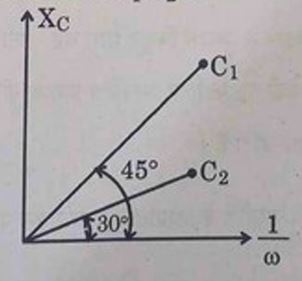
The figure shows the variation of capacitive reactance $(X_{C})$ of two ideal capacitors of capacitances $C_{1}$ & $C_{2}$ with the reciprocal of angular frequency $(1/\omega)$ of ac source. The value of $C_{1}/C_{2}$ is
(A) $\frac{1}{2}$
(B) 2
(C) $\sqrt{3}$
(D) $\frac{1}{\sqrt{3}}$
[1]
Note: For question numbers 13 to 16, two statements are given - one labelled as Assertion (A) and the other labelled as Reason (R). Select the correct answer from the codes (A), (B), (C) and (D) as given below:
(A) Both Assertion (A) and Reason (R) are true and Reason (R) is the correct explanation of Assertion (A).
(B) Both Assertion (A) and Reason (R) are true, but Reason (R) is not the correct explanation of Assertion (A).
(C) Assertion (A) is true, but Reason (R) is false.
(D) Assertion (A) is false and Reason (R) is also false.
(A) Both Assertion (A) and Reason (R) are true and Reason (R) is the correct explanation of Assertion (A).
(B) Both Assertion (A) and Reason (R) are true, but Reason (R) is not the correct explanation of Assertion (A).
(C) Assertion (A) is true, but Reason (R) is false.
(D) Assertion (A) is false and Reason (R) is also false.
13.
Assertion (A): Light added to light can produce darkness.
Reason (R): When two coherent light waves interfere, there is darkness at position of destructive interference.
Reason (R): When two coherent light waves interfere, there is darkness at position of destructive interference.
[1]
14.
Assertion (A): Two electric heaters of power $P_{1}$ and $P_{2}(\gt P_{1})$ are joined in series across a dc source of voltage V. The power consumed by the combination will be less than that consumed by $P_{1}$ when connected across the same source.
Reason (R): The power consumed by a electric device when connected to a dc source of voltage V is proportional to its resistance.
Reason (R): The power consumed by a electric device when connected to a dc source of voltage V is proportional to its resistance.
[1]
15.
Assertion (A): On increasing the intensity of incident light of frequency $v(\gt v_{0})$ on a photosensitive surface, the photocurrent increases.
Reason (R): The stopping potential for a photosensitive surface increases with increase of frequency $v(>v_{0})$ of incident light.
Reason (R): The stopping potential for a photosensitive surface increases with increase of frequency $v(>v_{0})$ of incident light.
[1]
16.
Assertion (A): On forward biasing a p-n junction diode, the height of the barrier potential increases.
Reason (R): In forward biasing of a p-n junction diode, the direction of the applied voltage is in the same direction as the built-in potential.
Reason (R): In forward biasing of a p-n junction diode, the direction of the applied voltage is in the same direction as the built-in potential.
[1]
SECTION B
(2 Marks Each)
17.
A 5 cm long pencil is placed along the principal axis of a concave mirror of focal length 20 cm such that its nearest end is at a distance of 25 cm from the mirror. Calculate the length of the image of the pencil.
OR
In a Young's double-slit experiment, a beam of light consisting of two wavelengths 500 nm and 600 nm is used. The interference fringes are observed at a screen placed 1.8 m away from the plane of slits (slit separation 0.3 mm). Calculate the least distance from the central maximum where the bright fringes due to both the wavelengths coincide.
[2]
18.
Calculate the temperature at which the resistance of a conductor becomes 20% more than its resistance at 27 °C. The value of the temperature coefficient of resistance of the material of conductor is $2.0\times10^{-4}{}^{\circ}\text{C}^{-1}$.
[2]
19.
A ray of light is incident on the face of a triangular prism of refracting angle 60° and it just suffers total internal reflection at the other face. Find the angle of incidence for the ray if the refractive index of the material of the prism is $\sqrt{2}$.
[2]
20.
Write two points of difference between intrinsic and extrinsic semiconductors.
[2]
21.
Find ratio $(\lambda_{a}/\lambda_{p})$ of the de Broglie wavelength $\lambda_{a}$ and $\lambda_{p}$ associated respectively with an alpha particle and a proton,
(i) if they are moving with the same kinetic energy.
(ii) just after they are accelerated through the same potential difference.
(i) if they are moving with the same kinetic energy.
(ii) just after they are accelerated through the same potential difference.
[2]
SECTION C
(3 Marks Each)
22.
(i) Define mutual inductance of a pair of coils. Write its SI unit.
(ii) A long solenoid of radius R and length L has n turns per unit length. A circular loop of radius $r( \lt R)$ is placed inside at the centre of the solenoid such that its axis coincides with the axis of the solenoid. Obtain the mutual inductance of the solenoid and the loop.
(ii) A long solenoid of radius R and length L has n turns per unit length. A circular loop of radius $r( \lt R)$ is placed inside at the centre of the solenoid such that its axis coincides with the axis of the solenoid. Obtain the mutual inductance of the solenoid and the loop.
OR
Two long straight parallel conductors A and B carrying steady currents $I_{a}$ and $I_{b}$ in the same direction are separated by a distance d. Deduce the expressions for the force acting on length L of conductor B due to conductor A and show it in figure. Write the expression for the force acting on length L of conductor A due to conductor B and show that it follows Newton's third law.
[3]
23.
Calculate the de Broglie wavelength associated with an electron revolving in the second excited state of hydrogen atom. The ground state energy of the hydrogen atom is - 13.6 eV. Take $m_{e}=9\times10^{-31}kg$, $h=6.6\times10^{-34}J.8.$
[3]
24.
Name the electromagnetic waves which are used
(i) as a diagnostic tool in medicine
(ii) in remote switches for TV sets
(iii) in water purifiers
Also write their wavelength range.
(i) as a diagnostic tool in medicine
(ii) in remote switches for TV sets
(iii) in water purifiers
Also write their wavelength range.
[3]
25.
(i) Draw electric field lines and equipotential surfaces for a system of two equal and opposite point charges separated by some distance.
(ii) Why electric field $\vec{E}$ at a point on an equipotential surface must be perpendicular to the surface at that point ?
(ii) Why electric field $\vec{E}$ at a point on an equipotential surface must be perpendicular to the surface at that point ?
[3]
26.
(a) Consider the following nuclides : ${}_{6}^{12}C$, ${}_{80}^{198}Hg$, ${}_{6}^{14}C$, ${}_{79}^{197}Au$. Group them into isotopes and isotones.
(b) How does the size of a nucleus depend on its mass number A? Hence prove that the density of nucleus is a constant, independent of A, for all nuclei.
(b) How does the size of a nucleus depend on its mass number A? Hence prove that the density of nucleus is a constant, independent of A, for all nuclei.
[3]
27.
Derive an expression for the magnetic field $\vec{B}$, due to a circular coil of N turns, each of radius r carrying current I, at a distance 'x' from the centre along its axis.
[3]
28.
(a) Explain the statement: "Current is a scalar although we represent current with an arrow".
(b) Use Kirchhoff's rules to find the current through 3 $\Omega$ resistor in the circuit shown in the figure: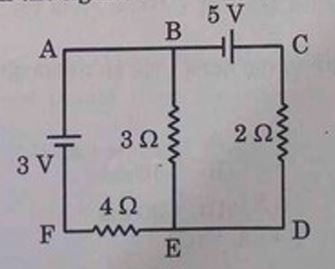
(b) Use Kirchhoff's rules to find the current through 3 $\Omega$ resistor in the circuit shown in the figure:
[3]
SECTION D
(4 Marks Case Study)
29.
Case Study Question
In an experiment with convex lens of focal length f, the screen is fixed at a distance D from the object. A student slowly moves the lens away from the object towards the screen and finds that she is able to form sharp image of the object for two positions of the lens. The distance between these two positions of the lens is d.
(i) The value of d is
(i) The value of d is
(A) $\sqrt{D(D-4f)}$
(B) $\sqrt{D(D-2f)}$
(C) $2\sqrt{Df}$
(D) $\sqrt{D(D-f)}$
(ii) Compared to the size of the object, the images formed in the two positions of the lens are respectively
(A) reduced, enlarged
(B) reduced, reduced
(C) enlarged, enlarged
(D) enlarged, reduced
(iii) If the distance between object and screen is 80.00 cm and the lens forms sharp images at two positions separated by 20.00 cm., the focal length of convex lens is
(A) 15.50 cm
(B) 18.75 cm
(C) 20.50 cm
(D) 22.75 cm
(iv) Consider a convex lens of focal length 15 cms. For which of the following values of object-screen distance, two positions of the object can be found to obtain sharp image on the screen?
(A) 45 cm
(B) 50 cm
(C) 55 cm
(D) 65 cm
OR
(iv) A thin convex lens of focal length 10 cm and another thin lens of focal length 'f' are placed coaxially in contact. If the power of their combination is $\frac{10}{3}D$ the value of 'f' is
(A) -15 cm
(B) -10 cm
(C) -20 cm
(D) -30 cm
[4]
30.
Case Study Question
A p-type or n-type semiconductor can be converted into a p-n junction by doping it with suitable impurity. The motion of majority charge carriers causes diffusion current across the junction while the barrier electric field causes motion of minority carriers for drift current. In case of unbiased diode, the diffusion and drift currents are equal. This equilibrium is disturbed by the biasing batteries. Diodes, therefore, allow currents in one direction. This property of diode is used in making rectifiers.
(i) Silicon is doped with which of the following to obtain p-type semiconductor?
(i) Silicon is doped with which of the following to obtain p-type semiconductor?
(A) Phosphorus
(B) Arsenic
(C) Boron
(D) Antimony
(ii) A semiconductor has an electron concentration of $5\times10^{22}m^{-3}$. The concentration of holes is (given $n_{i}=1.5\times10^{16}m^{-3})$
(A) $5\times10^{22}m^{-3}$
(B) $1.5\times10^{6}m^{-3}$
(C) $9\times10^{8}m^{-3}$
(D) $4.5\times10^{9}m^{-3}$
(iii) During forward biasing of a p-n junction diode, the
(A) current is mainly due to drifting of majority carriers.
(B) current is mainly due to drifting of minority carriers.
(C) diffusion and drift currents are equal.
(D) current is of the order of 1 $\mu$A.
(iv) The threshold voltage for silicon diode is about
(A) 0.2 V
(B) 0.5 V
(C) 0.7 V
(D) 1.5 V
OR
(iv) When we dope Ge with a pentavalent element, four of its electrons bond with four germanium neighbours but fifth electron remains weakly bound. The ionisation energy for this electron is about
(A) 0.01 eV
(B) 0.05 eV
(C) 0.1 eV
(D) 0.15 eV
[4]
SECTION E
(5 Marks Each)
31.
(a) A series combination of L, C and R is connected to an a.c. source. Using a phasor diagram, derive an expression for the impedance of the circuit and phase difference between V and I.
(b) Under what conditions the (i) impedance of the circuit is minimum ? (ii) Wattless current flows in the circuit?
(ii) Deduce an expression for the induced emf in the coil of the generator.
(iii) If T is the time period of the rotation of the coil, at what values of T in a cycle, the emf generator is maximum ?
(b) Under what conditions the (i) impedance of the circuit is minimum ? (ii) Wattless current flows in the circuit?
OR
(i) With the help of a labelled diagram, explain the principle, construction and working of an a.c. generator. (ii) Deduce an expression for the induced emf in the coil of the generator.
(iii) If T is the time period of the rotation of the coil, at what values of T in a cycle, the emf generator is maximum ?
[5]
32.
(a) What are coherent sources ? Why they are necessary for observing stable interference pattern ? Draw a graph showing the variation of intensity of light with the position on the screen in Young's double-slit experiment.
(b) Find the intensity of light at a point on the screen when two interfering waves of the same intensity $(I_{0})$ have a path difference of (i) $\frac{\lambda}{4}$ and (ii) $\frac{\lambda}{3}.$
(b) (i) In a telescope the objective has much larger aperture than the eye piece. Why?
(ii) Write two advantages of reflecting telescope over refracting telescope.
(b) Find the intensity of light at a point on the screen when two interfering waves of the same intensity $(I_{0})$ have a path difference of (i) $\frac{\lambda}{4}$ and (ii) $\frac{\lambda}{3}.$
OR
(a) Draw a labelled ray diagram of a refracting telescope when it forms image of a distant object at infinity. Derive expression for its magnifying power. (b) (i) In a telescope the objective has much larger aperture than the eye piece. Why?
(ii) Write two advantages of reflecting telescope over refracting telescope.
[5]
33.
(a) Derive an expression for the capacitance of a parallel plate capacitor of plate area A and plate separation d with air present between the plates.
(b) Two air-filled capacitors of capacitances $C_{1}$ and $C_{2}$ are connected in parallel with a dc battery. After the capacitors are fully charged, a slab of dielectric constant K is inserted between the plates of each capacitor. How will the (i) charge on each capacitor and (ii) energy stored in the capacitor affected after the slab is introduced.
(b) (i) This 'average velocity' is found be few mm/s for currents in range of a few amperes. How then is current established almost the instant a circuit is closed?
(ii) Two copper wires having their radii in the ratio of $3:2$ are connected in series across a battery. Find the ratio of the drift velocities of the electrons in the wires.
(b) Two air-filled capacitors of capacitances $C_{1}$ and $C_{2}$ are connected in parallel with a dc battery. After the capacitors are fully charged, a slab of dielectric constant K is inserted between the plates of each capacitor. How will the (i) charge on each capacitor and (ii) energy stored in the capacitor affected after the slab is introduced.
OR
(a) An electric field $\vec{E}$ is established across the ends of a cylindrical conductor of length L and area of cross-section A. Discuss how electrons attain an average velocity, independent of time. Hence, obtain a relation between current in the conductor and this 'average velocity' of electrons. (b) (i) This 'average velocity' is found be few mm/s for currents in range of a few amperes. How then is current established almost the instant a circuit is closed?
(ii) Two copper wires having their radii in the ratio of $3:2$ are connected in series across a battery. Find the ratio of the drift velocities of the electrons in the wires.
[5]