PHYSICS BYTES
HP BOARD FINAL QUESTION PAPER 2024
Subject: PHYSICS (Theory) | Class: XII | Series B
Time Allowed: 3 Hours
Maximum Marks: 60
GENERAL INSTRUCTIONS:
Candidates are required to give their answers in their own words as far as practicable. Marks allotted to each question are indicated against it.
- You must write Question Paper Series in the circle at top left side of title page of your Answer-book.
- While answering your Questions, you must indicate on your Answer-book the same Question No. as appears in your Question Paper.
- Do not leave blank page/pages in your Answer-book.
- The question paper has 29 questions. All the questions are compulsory. The Internal choice is given where applicable.
- Answers should be brief and to the point.
- Question Nos. 1 to 12 are MCQ carrying 1 mark each.
- Question Nos. 13 to 18 are very short answer type questions carrying 2 marks each.
- Question Nos. 19 to 26 are short answer type questions carrying 3 marks each and Question Nos. 27 to 29 carry 4 marks each.
- There is no negative marking.
SECTION - A
(1 Mark Each)
1.
SI unit of $\epsilon_{0}$ will be :
(a) $N^{-1}m^{-2}C^{-2}$
(b) $Nm^{-2}C^{2}$
(c) $N^{-1}m^{-2}C^{2}$
(d) $Nm^{-2}C^{-2}$
[1]
2.
Calculate current through a lamp of 60W operating at 220V:
(a) 2.73 A
(b) 27.3 A
(c) 0.0273 A
(d) 0.273 A
[1]
3.
Magnetic dipole moment is a Quantity directed from:
(a) South to North
(b) North to South
(c) East to West
(d) West to East
[1]
4.
Transformer does not work on:
(a) Both A.C. and D.C.
(b) A.C.
(c) D.C.
(d) None of these
[1]
5.
The Electromagnetic wave do not transport :
(a) energy
(b) charge
(c) momentum
(d) information
[1]
6.
The equivalent focal length 'F' of two thin lenses of focal lengths $f_{1}$ and $f_{2}$ in contact is :
(a) $f_{1}+f_{2}$
(b) $\sqrt{f_{1}f_{2}}$
(c) $\frac{f_{1}f_{2}}{f_{1}+f_{2}}$
(d) $f_{1}-f_{2}$
[1]
7.
The de-Broglie equation states :
(a) dual nature
(b) particle nature
(c) wave nature
(d) None of these
[1]
8.
Hydrogen bomb is based on the principle of :
(a) Nuclear fission
(b) $\alpha$-decay
(c) Nuclear fusion
(d) None of these
[1]
9.
Depletion layer consists of :
(a) Electrons
(b) Immobile ions
(c) Mobile ions
(d) Both (a) and (b)
[1]
10.
A T.V. transmission tower has a height of 240 m. Signals broadcast from this tower will be received by LOS communication at a distance of (Assume the radius of Earth to be $6.4\times10^{6}m$).
(a) 100 km
(b) 24 km
(c) 55 km
(d) 50 km
[1]
11.
Which of the following is not due to total internal reflection of light?
(a) brilliance of diamond
(b) working of optical fibre
(c) difference between apparent and real depth of a pond
(d) mirage on hot summer day
[1]
12.
Which of the following does not support the wave nature of light?
(a) Interference
(b) Diffraction
(c) Polarisation
(d) Photoelectric effect
[1]
SECTION - B
(2 Marks Each)
13.
Define the Equipotential surfaces. Give its two properties.
[2]
14.
Define self inductance of a Coil. Write its S.I. unit.
[2]
15.
Write four Maxwell's equations.
(a) Infra red rays
(b) Gamma rays
(c) Microwaves
(d) Ultraviolet radiations.
OR
Give one use of each : (a) Infra red rays
(b) Gamma rays
(c) Microwaves
(d) Ultraviolet radiations.
[2]
16.
Find the de-Broglie wavelength of an Electron accelerated between two points having potential difference of 'V' volts.
[2]
17.
Give the logic symbol, truth table and Boolean expression of OR Gate.
OR
Explain the Forward biasing and Reverse biasing.
[2]
18.
What do you mean of dispersion of light? What is the cause of dispersion?
OR
Explain the difference between Diffraction and Interference of Light.
[2]
SECTION - C
(3 Marks Each)
19.
Define the drift velocity and derive an expression for it.
[3]
20.
(a) Define internal resistance of a cell.
(b) What is resistance between parts A and B in the circuit shown?
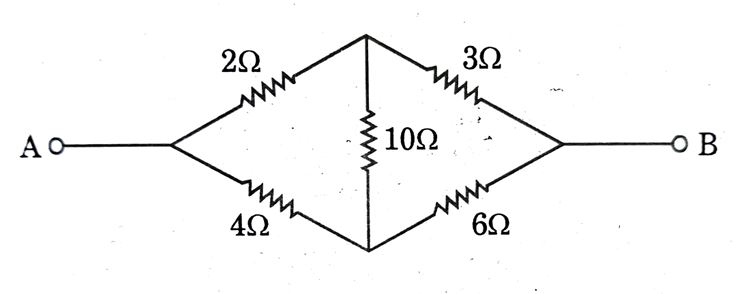
(b) What is resistance between parts A and B in the circuit shown?
[3]
21.
What are magnetic elements of Earth's magnetism? Explain them.
OR
What is a Voltmeter? How can a galvanometer be converted into a Voltmeter?
[3]
22.
What is Solenoid? Obtain an expression for magnetic field on the axis of long straight solenoid using Ampere's circuital law?
[3]
23.
State Huygen's principle. Using this principle, prove the laws of reflection.
[3]
24.
Draw and explain a graph showing the variation of binding energy per nucleon with mass number for nuclei.
Given :
mass of $_{3}Li^{6} = 6.015126$ amu
mass of $_{2}He^{4} = 4.0026044$ amu
mass of neutron $(_{0}n^{1}) = 1.0086654$ amu
mass of tritium $(_{1}H^{3}) = 3.016049$ amu.
OR
A Neutron is absorbed by $_{3}Li^{6}$ nucleus with subsequent emission of $\alpha$-particle. Write the corresponding nuclear reaction. Calculate the Energy released in this reaction in MeV.Given :
mass of $_{3}Li^{6} = 6.015126$ amu
mass of $_{2}He^{4} = 4.0026044$ amu
mass of neutron $(_{0}n^{1}) = 1.0086654$ amu
mass of tritium $(_{1}H^{3}) = 3.016049$ amu.
[3]
25.
Explain through a diagram working of a transistor as an oscillator.
OR
Distinguish between n-type and p-type semiconductor.
[3]
26.
Prove that $d=\sqrt{2hR}$, for TV signals received on the surface of Earth.
[3]
SECTION - D
(4 Marks Each)
27.
What is a parallel plate capacitor? Derive a relation for capacitance of a parallel plate capacitor with di-electric slab introduced in between its plates.
OR
What is an Electric dipole? Derive an expression for torque on Electric dipole when Electric dipole is placed in uniform Electric field. What is the Net force acting on the Electric dipole?
[4]
28.
Find the expression for power in an a.c. containing L, C and R. What will be the power of a circuit having :
(i) only R
(ii) only L.
(i) only R
(ii) only L.
[4]
29.
Define the Magnifying power of an astronomical telescope. Derive an expression for its magnifying power; when final image is at least distance of distinct vision.
When refraction occurs from rarer to denser medium at a concave spherical refracting surface.
OR
Prove that: $-\frac{\mu_{1}}{u}+\frac{\mu_{2}}{v}=\frac{\mu_{2}-\mu_{1}}{R}$ When refraction occurs from rarer to denser medium at a concave spherical refracting surface.
[4]