PHYSICS BYTES
Rank Booster Test Series - 03
TOPIC : System of Particles and Rotational Motion, Gravitation
BEWARE OF NEGATIVE MARKING
1.
A circular disc of radius R and thickness R/6 has moment of inertia I about an axis passing through its centre perpendicular to its plane. It is melted and recasted into a solid sphere. The moment of inertia of the sphere about its diameter as axis of rotation is :
2.
A small disc of radius 2 cm is cut from a disc of radius 6 cm. If the distance between their centres is 3.2 cm, what is the shift in the centre of mass of the disc:
3.
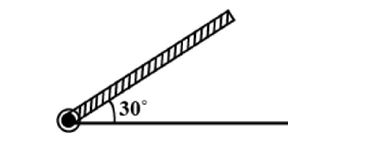
A rod of length 50 cm is pivoted at one end. It is raised such that it makes an angle of $30^{\circ}$ from the horizontal as shown and released from rest. Its angular speed when it passes through the horizontal (in rad s⁻¹) will be $(g=10ms^{-2})$
4.
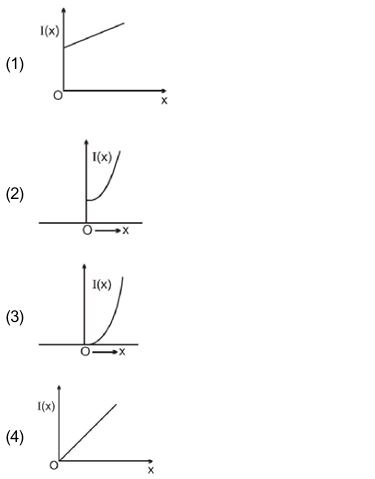
The moment of inertia of a solid sphere about an axis parallel to its diameter and at a distance of x from it, is $I(x)$. Which one of the graphs represents the variation of I(x) with x correctly:
5.
Moment of inertia of a body about a given axis is $1.5kg~m^{2}$. Initially the body is at rest. In order to produce a rotational kinetic energy of 1200J, the angular acceleration of $20~rad/s^{2}$ must be applied about the axis for a duration of:
6.
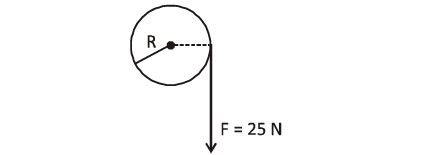
A chord of negligible mass is wound round the rim of a disc of mass 20 kg and radius 20 cm. A steady pull of 25 N is applied on the cord as shown in figure. The flywheel is mounted on a horizontal axle with frictionless bearings. Find angular acceleration :
7.
A body of mass m rises to height $h=R/5$ from the earth's surface, where R is earth's radius. If g is acceleration due to gravity at earth's surface, the increase in potential energy is :
8.
The value of escape velocity on a certain planet is $2~km/s.$ Then the value of orbital speed for a satellite orbiting close to its surface is :
9.
In a satellite if the time of revolution is T, then K.E. is proportional to:
10.
Two planets of mass $m_{1}$ and $m_{2}$ are at distance r from each other. What is the escape velocity of a satellite of mass m projected from the mid point of two planets:
11.
At what height the gravitational field reduces by 75% the gravitational field at the surface of earth?
12.
Which of the following quantities remains constant in a planetory motion (consider elliptical orbits) as seen from the sun :
13.
The weight of the body at the centre of earth is :
14.
Two identical metal spheres of same material of density 'd' are touching each other. What is the gravitational force of attraction between them?
15.
Two small bodies initially both at rest and free to move from a distance of 1m from each other, are subjected to only their gravitational force of attraction. They approach each other and collide and do not separate. In respect of this collision which of the following statement is true:
16.
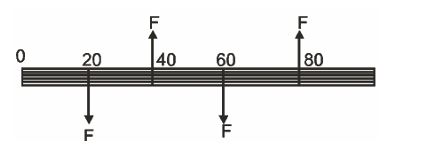
Four equal and parallel forces are acting on a rod (as shown in figure) at distances of 20 cm, 40 cm, 60 cm and 80 cm respectively from one end of the rod. Under the influence of these forces the rod :
17.
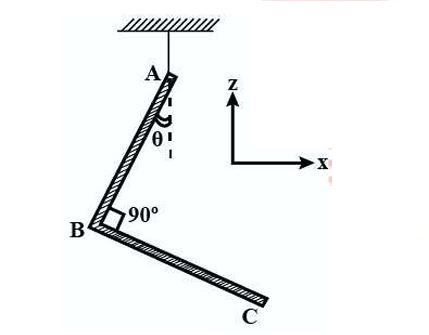
An L-shaped object, made of thin rods of uniform mass density, is suspended with a string as shown in figure. If $AB=BC,$ and the angle made by AB with downward vertical is $\theta$, then:
18.
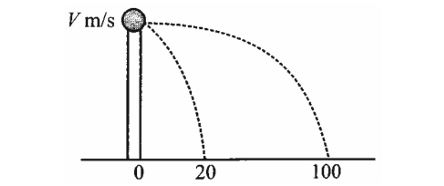
A ball of mass 0.2 kg rests on a vertical post of height 5 m. A bullet of mass 0.01 kg, travelling with a velocity $v~m/s$ in a horizontal direction, hits the centre of the ball. After the collision, the ball and bullet travel independently. The ball hits the ground at a distance of 20 m and the bullet at a distance of 100 m from the foot of the post. The initial velocity V of the bullet is:
19.
A planet of mass m revolves around the sun of mass M in an elliptical orbit. The minimum and maximum distance of the planet from the sun are $r_{1}$ and $r_{2}$ respectively. If the minimum velocity of the planet is $\sqrt{\frac{2GMr_{1}}{(r_{1}+r_{2})r_{2}}}$ then it's maximum velocity will be :
20.
Choose the correct alternatives:
21.
A thick straight wire of length $\pi$ m is fixed at its midpoint and then bent in the form of a circle. The shift in its centre of mass is
22.
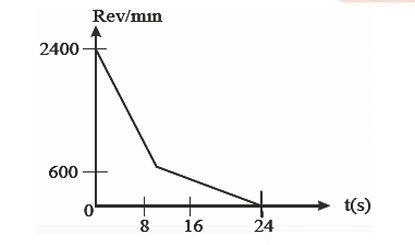
A table fan, rotating at a speed of 2400 rpm is switched off and the resulting variation of the rpm with time is shown in the figure. The total number of revolutions of the fan before it comes to rest is
23.
A projectile of mass 3 kg explodes at highest point of its path. It breaks into three equals parts. One part retraces its path, the second one comes to rest. The range of the projectile was 100 m if no explosion would have taken place. The distance of the third part from the point of projection when it finally lands on the ground is:
24.
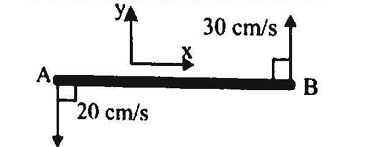
A 100 cm rod is moving on a horizontal surface. At an instant, when it is parallel to the x-axis its ends A and B have velocities $30~cm/s$ and $20~cm/s$ as shown in the figure. Find velocity of its centre.
25.
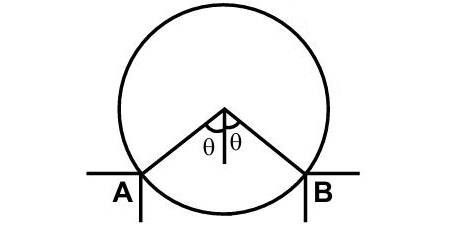
A cylinder of radius r and mass m rests on two horizontal parallel corners of two platforms. Both the platforms are of the same height. Platform B is suddently removed. Assume friction between the corner of the platform A and cylinder to be sufficient enough to prevent sliding. Determine angular acceleration of the cylinder immediately after the removal of the platform B.
26.
A circular disc of radius R is free to rotate about an axis passing through its centre. An external tangential force F is applied on the disc along its edge. If the angular velocity of disc is increased from 0 to $\omega$ in a time t then the work done by F during same time t is:
27.
A string is wrapped around a cylinder of mass M and radius R. The string is pulled vertically upward to prevent the centre of mass from falling as the cylinder upwinds the string. Find the length of the string unwound when the cylinder has reached a speed $\omega$:
28.
A circular disc of mass M and radius R is rotating with an agular velocity $\omega$ about an axis passing through its centre and perpendicular to the plane of the disc. A small point like part of mass m detaches from the rim of the disc and continues to move with same angular speed. The angular velocity of remaining disc just after detaching will become:
29.
An engine develops 100 kW, when rotating at 1800 rpm. Torque required to deliver the power is
30.
A hollow sphere of mass 1 kg and radius 10 cm is free to rotate about its diameter. If a force of 30 N is applied tangentially to it, its angular acceleration is $(in~rad/s^{2})$
31.
A satellite of mass m is orbiting the earth (of radius R) at a height h from its surface. The total energy of the satellite in terms of $g_{0}$, the value of acceleration due to gravity at the earth's surface, is
32.
A satellite of mass m is orbiting around the earth in a circular orbit with a velocity v. What will be its total energy?
33.
A body of mass m is placed on earth's surface which is taken from earth surface to a height of $h=3R$ then change in gravitational potential energy is
34.
A thin circular ring of mass M and radius r is rotating about its axis with a constant angular velocity $\omega$. Four objects each of mass m, are kept gently to the opposite ends of two perpendicular diameters of the ring. The angular velocity of the ring will be
35.
A circular platform a mounted on a frictionless vertical axle. Its radius $R=2$ m and its moment of inertia about the axle is $200~kg~m^{2}.$ It is initially at rest. A 50 kg man stands on the edge of the platform and begins to walk along the edge at the speed of $1~ms^{-1}$ relative to the ground. Time taken by the man to complete one revolution is
36.
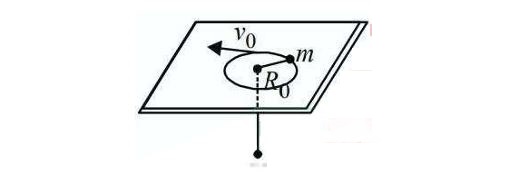
A mass m moves in a circle on a smooth horizontal plane with velocity $v_{0}$ at a radius $R_{0}.$ The mass is attached to a string which passes through a smooth hole in the plane as shown. The tension in the string is increased gradually and finally m moves in a circle of radius $R_{0}/2.$ The final value of the kinetic energy is
37.
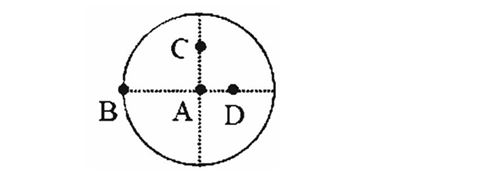
The moment of inertia of a uniform circular disc is maximum about an axis perpendicular to the disc and passing through
38.
A 3 m long ladder weighing 20 kg leans against a frictionless vertical wall. The foot of the ladder is 1 m from the wall. What is the reaction force at the wall?(Take $g=10~m/s^{2})$
39.
Torques of equal magnitude are applied to a hollow cylinder and a solid sphere, each having the same mass and radius. Both rotate freely about their respective axes. Which object acquires a greater angular speed after a given time?
40.
A metre stick is balanced at its centre. When two 5 g coins are placed one over the other at the 12.0 cm mark, the stick becomes balanced at 45.0 cm. What is the mass of the metre stick?
41.
An oxygen molecule has rotational KE equal to two-thirds of its translational KE. If its translational speed is $500~m/s$, its moment of inertia is $1.94\times10^{-46}kgm^{2}$, and mass is $5.20\times10^{-26}$ kg, what is the order of magnitude of average angular velocity of the molecule?
42.
For a system of particles, the time rate of change of total angular momentum about a point is equal to:
43.
For a particle rotating with speed $v=\omega r_{i}$, the component of angular momentum along the fixed axis is
44.
The center of mass of a system of particles depends on:
45.
The gravitational potential energy of two masses separated by distance r is: