PHYSICS BYTES
Rank Booster Test Series - 06
TOPIC : MODEL-01 (RBTS-1 to RBTS-5)
BEWARE OF NEGATIVE MARKING
1.
A student measured the diameter of a small steel ball using a screw gauge of least count 0.001 cm. The main scale reading is 5 mm and zero of circular scale division coincides with 25 divisions above the reference level. If screw gauge has a zero error of -0.004 cm, the correct diameter of the ball is:
2.
A balloon is rising vertically upwards at a velocity of $10~ms^{-1}$. When it is at a height of 45 m from the ground, a parachutist bails out from it. After 3s he opens his parachute and decelerates at a constant rate of $5~ms^{-2}$. After how long does the parachutist hit the ground after his exit from the balloon:
3.
Internal energy of $n_{1}$ moles of hydrogen gas at temperature T is equal to internal energy of $n_{2}$ moles of helium gas at temperature 3T. Then the ratio $n_{1}/n_{2}$ is:
4.
Assertion: Maxwell speed distribution graph is symmetric about most probable speed. Reason: rms speed of ideal gas, depends upon it's type (monoatomic, diatomic and polyatomic).
5.
In figure, the block A, B and C of mass m each have accelerations $a_{1}, a_{2}$ and $a_{3}$ respectively. $F_{1}$ and $F_{2}$ are external forces of magnitudes 2mg and mg respectively. Then:

6.
The value of the gravitational potential energy of a system of four particles of equal masses placed at the corners of a square of side 'l'.
7.
A mass 'M' is suspended from a spring of negligible mass. The spring is pulled a little and then released. It executes S.H.M. oscillations of period T. When mass is increased by 'm' the period becomes $\frac{5}{4}T$, the ratio of $m/M$ is:
8.
If $\vec{C}=\vec{A}+\vec{B}$ and $\vec{A}\perp\vec{B}$ and $|C|=2|B|$ then find angle between $\vec{A}$ and $\vec{C}$:
9.
A particle is moving along a straight line such that its acceleration $a=A+\frac{B}{s^{2}}$ what is the velocity of particle when it is at $s=10$ [at $s=1, v=0$]
10.
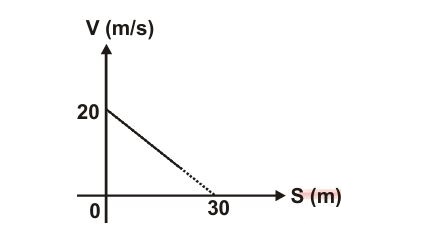
If the velocity v of a particle moving along a straight line decreases linearly with its displacement s from 20 m/s to a value approaching zero at $s=30~m$, then acceleration of the particle at $v=10~m/s$ is:
11.
A particle is projected with velocity $V_{0}$ along x axis. The deceleration on particle is proportional to the square of the distance from the origin i.e $a=\alpha x^{2}$, the distance at which the particle stops is -
12.
A particle of mass m moves with constant speed along a circular path of radius r under the action of a force F. Its speed is
13.
An ideal gas is taken through a four step cyclic thermo dynamical process through four steps heat given in this process the total heats applied is $Q=3645~J$. The corresponding works involved are $W_{1}=2200~J, W_{2}=-825~J, W_{3}=-1100~J$ and $W_{4}$ respectively. The value of $W_{4}$ is:
14.
An asteroid of mass m is approaching earth, initially at a distance of 10 $R_{e}$ from centre of earth with speed $V_{1}$. It hits the earth with a speed V, (R and M radius and mass of earth), then :
15.
A spherical ball A of mass 4 kg, moving in a straight line strikes another spherical ball B of mass 1 kg at rest. After the collision, A and B move with velocities $V_{1}m/s$ and $V_{2}m/s$ respectively makes angles of $30^{\circ}$ and $60^{\circ}$ with respect to the original direction of motion of A, the ratio $\frac{V_{1}}{V_{2}}$ will be :
16.
The temperature of n moles of an ideal gas is increased from T to 4T through a process for which pressure $P=\frac{a}{T}$ where a is constant. The work done by gas is:
17.
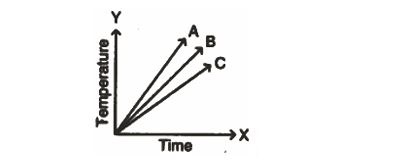
Which of the substances A, B and C has the lowest heat capacity, if heat is supplied to all of them at equal rates. The temperatures versus time graph is shown:
18.
A particle having a mass 0.5 kg is projected under gravity with a speed of $98~m/s$ at an angle of $60^{\circ}$. The magnitude of the change in momentum in N/sec of the particle after 10 sec is: $(g=9.8~m/s^{2})$
19.
The length of the second's pendulum on the surface of earth is 1 m. The length of second's pendulum on the surface of moon, where g is $(1/6)th$ value of earth surface, is:
20.
The refractive index of water measured by the relation $\mu=\frac{real~depth}{apparent~depth}$ is found to have values of 1.34, 1.38, 1.32 and 1.36; the mean value of refractive index with percentage error is
21.
A formula is given as $P=\frac{b}{a}\sqrt{1+\frac{k.\theta.t^{3}}{m.a}}$ where P = pressure, k = Boltzmann's constant. Dimensional formula of 'b' is same as
22.
A particle moving with velocity $\vec{v}=k(y\hat{i}+x\hat{j})$, where k = constant. The general equation for its path is [$C=$ constant]
23.
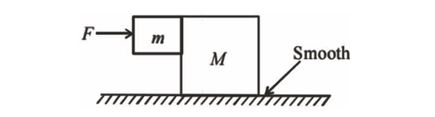
The two blocks, $m=10$ kg and $M=50$ kg are free to move as shown. The coefficient of static friction between the blocks is 0.5 and there is no friction between M and the ground. A minimum horizontal force F is applied to hold m against M that is equal to
24.
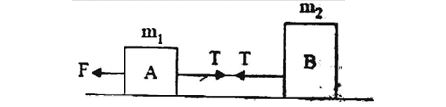
Which of the following is true about acceleration, a for the system?
25.
Which of the following statements are incorrect?
I. Action and reaction forces act along the line joining the centres of two bodies.
II. Newton's third law is applicable whether the bodies are at rest or in motion.
III. A single isolated force can exist.
IV. There is no cause effect relation between action and reaction.
I. Action and reaction forces act along the line joining the centres of two bodies.
II. Newton's third law is applicable whether the bodies are at rest or in motion.
III. A single isolated force can exist.
IV. There is no cause effect relation between action and reaction.
26.
A bullet losses (1/n)th of its velocity passing through one plank. The number of such planks that are required to stop the bullet can be:
27.
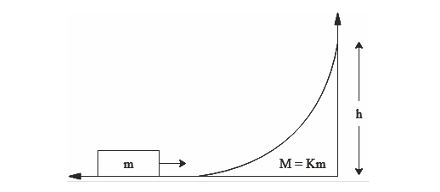
A block of mass m is moved towards a movable wedge of mass M = km and height h with velocity u (All the surface are smooth). If the block just reaches the top of the wedge, the value of u is
28.
A body A of mass M while falling vertically downwards under gravity breaks into two parts; a body B of mass $1/3$ M and a body C of mass $2/3$ M. The centre of mass of bodies B and C taken together shifts compared to that of body A
29.
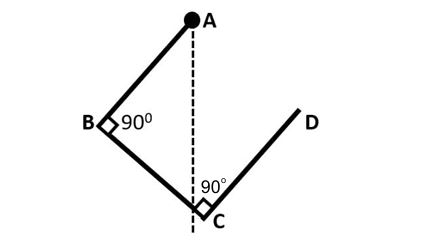
Three identical rods are hinged at point A as shown. The angle made by rod AB with vertical is
30.
The least energy required to launch a satellite of mass 100 kg from the surface of a planet of mass M and radius 3200 km in a circular orbit at an altitude of 6400 km is:
31.
Select the incorrect statements from the following.
I. The orbital velocity of a satellite increases with the radius of the orbit.
II. Escape velocity of a particle from the surface of the earth depends on the speed with which it is fired.
III. The time period of a satellite does not depend on the radius of the orbit
IV. The orbital velocity is inversely proportional to the square root of the radius of the orbit.
I. The orbital velocity of a satellite increases with the radius of the orbit.
II. Escape velocity of a particle from the surface of the earth depends on the speed with which it is fired.
III. The time period of a satellite does not depend on the radius of the orbit
IV. The orbital velocity is inversely proportional to the square root of the radius of the orbit.
32.
For a satellite orbiting in an orbit, close to the surface of earth, to escape, what is the percentage increase in the kinetic energy required?
33.
A partition wall has two layers of different materials A and B in contact with each other. They have the same thickness but the thermal conductivity of layer A is twice that of layer B. At steady state the temperature difference across the layer B is 50 K, then the corresponding difference across the layer A is
34.
The top of an insulated cylindrical container is covered by a disc having emissivity 0.6 and conductivity 0.167 $WK^{-1}m^{-1}$ and thickness 1 cm. The temperature is maintained by circulating oil. Find the radiation loss to the surrounding in $Jm^{-2}s^{-1}$ if temperature of the upper surface of the disc is $127^{\circ}C$ and temperature of the surrounding is $27^{\circ}C$.
35.
A cube of side 5 cm made of iron and having a mass of 1500 g is heated from $25^{\circ}C$ to $400^{\circ}C$. The specific heat for iron is 0.12 $cal/g^{\circ}C$ and the coefficient of volume expansion is $3.5\times10^{-5}/^{\circ}C$. The change in the internal energy of the cube is (atm pressure $=1\times10^{5}N/m^{2}$)
36.
Calculate the value of mean free path ($\lambda$) for oxygen molecules at temperature $27^{\circ}C$ and pressure $1.01\times10^{5}$ Pa. Assume the molecular diameter 0.3 nm and the gas is ideal. $(k=1.38\times10^{-23}JK^{-1})$
37.
The temperature of a gas is $-50^{\circ}C$. To what temperature the gas should be heated so that the rms speed is increased by 3 times?
38.
The density of air at pressure of $10^{5} Nm^{-2}$ is $1.2 kg~m^{-3}$. Under these conditions, the root mean square velocity of the air molecules in $ms^{-1}$ is
39.
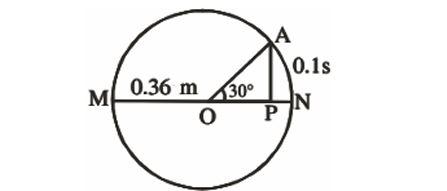
The point A moves with a uniform speed along the circumference of a circle of radius 0.36 m and covers $30^{\circ}$ in 0.1 s. The perpendicular projection 'P' from 'A' on the diameter MN represents the simple harmonic motion of 'P'. The restoring force per unit mass when P touches M will be
40.
The displacement of a particle is represented by the equation $y=3~\cos(\frac{\pi}{4}-2\omega t)$. The motion of the particle is
41.
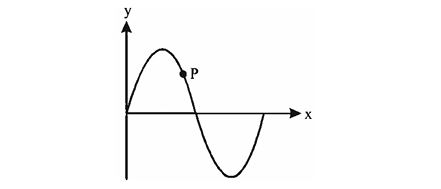
A transverse sinusoidal wave moves along a string in the positive x-direction at a speed of $10~cm/s$. The wavelength of the wave is 0.5 m and its amplitude is 10 cm. At a particular time t, the snap-shot of the wave is shown in figure. The velocity of point P when its displacement is 5 cm is
42.
A tuning fork is used to produce resonance in a glass tube. The length of the air column in this tube can be adjusted by a variable piston. At room temperature of $27^{\circ}C$ two successive resonances are produced at 20 cm and 73 cm of column length. If the frequency of the tuning fork is 320 Hz, the velocity of sound in air at $27^{\circ}C$ is
43.
A tuning fork arrangement (pair) produces 4 beats/sec with one fork of frequency 288 cps. A little wax is placed on the unknown fork and it then produces $2~beats/sec$. The frequency of the unknown fork is :
44.
A student measures the time period of 100 oscillations of a simple pendulum four times. The data set is 90 s, 91 s, 95 s and 92 s. If the minimum division in the measuring clock is 1 s, then the reported mean time should be :
45.
To determine the speed of sound in air at room temperature we use a