PHYSICS BYTES
Rank Booster Test Series - 07
TOPIC : Mechanical Properties of Solid and Fluid Experimental Skills
BEWARE OF NEGATIVE MARKING
1.
The following four wires of length L and radius r are made of the same material. Which of these will have the largest extension when the same tension is applied:
2.
The rubber cord of a catapult is pulled back until its original length has been doubled. Assuming that the cross-section of the cord is square of side 2 mm square and that Y for rubber is $1\times10^{7}N/m^{2}$ what is the tension in the cord:
3.
Which of the following is most elastic:
4.
Which elasticity is associated with liquids:
5.
A steel wire is suspended vertically from a rigid support. When loaded with a weight in air, it extends by $I_{a}$ and when emerging in a water, the extension is reduced to $I_{w}$. Then the relative density of the material of the weight is:
6.
A wire can sustain the weight of 20 kg before breaking. If the wire is cut into two equal parts, each part can sustain a weight of:
7.
A wire elongates by 1.0 mm when a load W is hanged from it. If the wire goes over a pulley and two weights W each are hung at the two ends the elongation of the wire will be:
8.
An elastic metal rod will change its length when it:
9.
Two equal and opposite force F and -F act on a rod of uniform cross sectional area A, as shown in figure. Longitudinal stress on the section AB is

10.
An elongation of 0.1% in a wire of cross-sectional area $10^{-6}m^{2}$ causes a tension of 100 N. The Young's modulus is:
11.
A wire of length L and radius r is fixed at one end and force F applied to the other and produces an extension y. The extension produced in another wire of the same material of length 2L and radius 2r by a force 2F is:
12.
For a perfectly rigid body:
13.
A metallic cube of bulk modulus $1.35\times10^{11}N/m^{2}$ is placed in vacuum from air then fractional change in its length
14.
Length of an elastic string is 'a' metre when the tension is 4 Newton and 'b' metre when the tension is 5 newton. Length in metre when the tension is 9 newton is:
15.
What is Hook's Law:
16.
A spherical ball is compressed by 0.01% when a pressure of 100 atmosphere is applied on it. Its bulk modulus of elasticity in dyne/cm² will be approximately:
17.
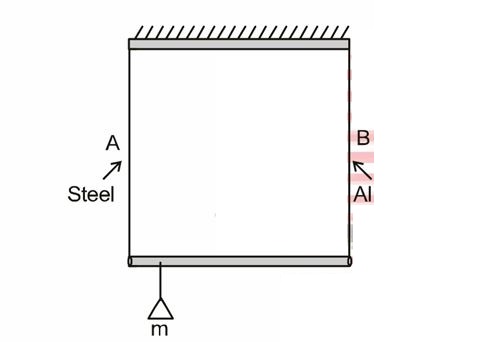
A rod of length L and negligible mass is suspended at its two ends by two wires of steel (wire A) and aluminium (wire B) of equal lengths. The cross-sectional areas of wires A and B are $1.0~mm^{2}$ and $2.0~mm^{2}$ respectively: $(Y_{Al}=70\times10^{9}Nm^{-2}$ and $Y_{steel}=200\times10^{9}Nm^{-2})$
18.
For an ideal liquid:
19.
A copper and a steel wire of the same diameter are connected end to end. A deforming force F is applied to this composite wire which causes a total elongation of 1cm. The two wires will have:
20.
The surface tension of water can be reduced by:
21.
A Liquid in a cylindrical vessel of radius 0.05 meter is rotated along with the vessel about its axis with a speed of 4 radian/sec. The rise in liquid level will be $(g=10~m/sec^{2})$
22.
The velocity of a small ball of mass m and density $d_{1}$, when dropped in a container filled with glycerine becomes constant after some time. If the density of glycerine is $d_{2}$, the viscous force acting on the ball will be:
23.
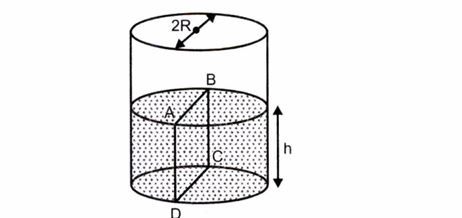
Water is filled up to a height h in a beaker of radius R as shown in the figure. The density of water is p, the surface tension of water is T and the atmospheric pressure is $P_{0}$. Consider a vertical section of ABCD of the water column through a diameter of the beaker. The force on water on one side of this section by water on other side of this section has magnitude:
24.
The height of water level in a tank is H. The range of water stream coming out of a hole at depth H/3 from upper water level will be:
25.
One soap bubble P has radius r, another Q has radius 2r. The two come into contact to form a common interface wall. The radius of curvature of this wall will be:-
26.
Three equal drops are falling through air with a steady velocity of $2cm/sec$. If the drops coalesce, the new terminal velocity will be:
27.
The excess pressure in a bubble of radius R of a gas in a liquid of surface tension S is
28.
The amount of work done in increasing the size of a soap film $10~cm\times6~cm$ to $10~cm\times10~cm$ is (Surface tension $T=0.030~N/m$):
29.
In a surface tension experiment with a capillary tube water rises upto 0.1 m. If the same experiment is repeated on an artificial satellite, which is revolving around the earth, water will rise in the capillary tube upto a height of:
30.
A wooden ball of density p is dropped from rest from a height 'h' into the lake of water density $\sigma$ ($\sigma > p$). Neglecting viscosity, the maximum depth to which the body sinks before returning to float is:
31.
Water rises to a height of 10 cm in capillary tube and mercury falls to a depth of 3.42 cm in the same tube. If the density of mercury is 13.6 g/cc and the angle of contact is $135^{\circ}$, the ratio of surface tension for water and mercury is
32.
If two soap bubbles of different radii are connected by a tube then:
33.
Spherical balls of radius R are falling in a viscous fluid of viscosity $\eta$ with a velocity v. The retarding viscous force acting on the spherical ball is:
34.
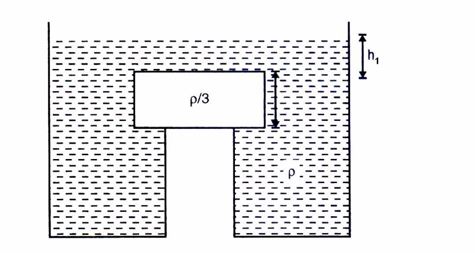
A wooden cylinder of diameter 4r height H and density $\frac{\rho}{3}$ is kept on a hole of diameter 2r of a tank filled with water of density $\rho$ as shown in the figure. If level of liquid starts decreasing slowly when the level of liquid is at a height $h_{1}$ above the cylinder the block just starts moving up. Then value of $h_{1}$ is:
35.
Match the column I and column II:
Column I
A. Hydraulic lift
B. Viscous force
C. Energy conservation
D. Speed of efflux
Column II
1. Torricelli's law
2. Bernoulli's principle
3. Pascal's law
4. Stoke's law
Column I
A. Hydraulic lift
B. Viscous force
C. Energy conservation
D. Speed of efflux
Column II
1. Torricelli's law
2. Bernoulli's principle
3. Pascal's law
4. Stoke's law
36.
Statement I: When height of a tube is less than liquid rise in the capillary tube, the liquid does not overflow.
Statement II: Product of radius of meniscus and height of liquid in capillary tube always remains constant.
Statement II: Product of radius of meniscus and height of liquid in capillary tube always remains constant.
37.
Which of the following statement's is/are true?
I. For gases, in general, viscosity increases with temperature.
II. For liquids, viscosity varies directly with pressure
III. For gases, viscosity is independent of pressure.
IV. With increase in temperature, the viscosity of both liquids and gases increases
I. For gases, in general, viscosity increases with temperature.
II. For liquids, viscosity varies directly with pressure
III. For gases, viscosity is independent of pressure.
IV. With increase in temperature, the viscosity of both liquids and gases increases
38.
Assertion: Surface tension of all lubricating oils and paints is kept high.
Reason: Due to high value of surface tension the fluids don't get damaged.
Reason: Due to high value of surface tension the fluids don't get damaged.
39.
A cylinder with movable piston contains air under pressure $P_{0}$ and a soap bubble of radius r. The surface tension of soap solution is T and the temperature of the system is kept constant. The pressure to which the air should be compressed by slowly pushing the piston into the cylinder for the soap bubble to reduce its size (radius) by half is:
40.
The flow speeds of air on the lower and upper surfaces of the wing of an aeroplane are v and $\sqrt{2}v$ respectively. The density of air is p and surface area of wing is A. The dynamic lift on the wing is:
41.
A soap bubble with a radius 'r' is placed on another bubble with a radius R. Angles between the films at the points of contact will be:
42.
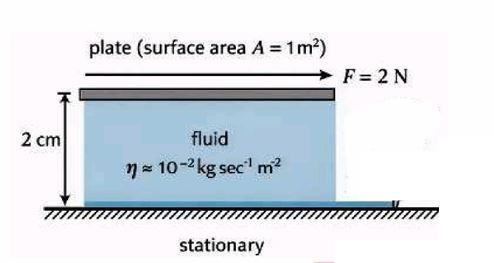
In the given figure if force of 2N is required to maintain constant velocity of plate, the velocity of upper plate is:
43.
A copper wire $(Y=10^{11}N/m^{2})$ of length 8 m and a steel wire $(Y=2\times10^{11}N/m^{2})$ of length 4 m each of $0.5~cm^{2}$ cross section are fastened end to end and stretched with a tension of 500 N.
Column I
A. Elongation in copper wire in mm
B. Elongation in steel wire in mm
C. Total elongation in mm
D. Elastic potential energy of the system in joules
Column II
1. 0.25
2. 1.0
3. 0.8
4. 1/4th of the elongation in copper wire
5. 7500
Column I
A. Elongation in copper wire in mm
B. Elongation in steel wire in mm
C. Total elongation in mm
D. Elastic potential energy of the system in joules
Column II
1. 0.25
2. 1.0
3. 0.8
4. 1/4th of the elongation in copper wire
5. 7500
44.
A body of mass 10 kg is attached to a wire of radius 3 cm. It's breaking stress is $4.8\times10^{6}Nm^{-2}$, the area of cross section of the wire is $10^{-6}m^{2}$. What is the maximum angular velocity with which it can be rotated in the horizontal circle?
45.
A large tank is moving vertically upward with a constant acceleration a. The tank is filled with water up to a height H, measured in the frame of the tank. A small hole is made in one of the vertical side walls of the tank at a height x from the bottom. If acceleration due to gravity is g, find the speed of efflux of water from the hole.