PHYSICS BYTES
Rank Booster Test Series - 10
TOPIC : Moving Charges and Magnetism, Magnetism and Matter, Electromagnetic Induction, Alternating Current, Electromagnetic Waves
BEWARE OF NEGATIVE MARKING
1.
A small rod made of a magnetic material is freely suspended by a thin thread at a place on Earth. When the rod is placed in the magnetic field, it is found that the rod aligns itself perpendicular to the direction of the magnetic field. The material of the rod is most likely to be:
2.
A charged particle and a current-carrying conductor are placed in a uniform magnetic field. Consider the following statements: Statement I: The magnetic force on a charged particle moving parallel to a magnetic field is zero. Statement II: A charged particle moving perpendicular to a magnetic field experiences maximum magnetic force. Statement III: A current-carrying conductor placed parallel to a magnetic field experiences no magnetic force. Statement IV: The direction of magnetic force on a current-carrying conductor can be determined using Fleming's right-hand rule. Which of the above statements are correct?
3.
The magnetic field dB due to a small current element di at a distance r and element carrying current is:
4.
A solenoid at 1.5 metre length and 4.0 cm diameter posses 10 turn per cm. A current of 5 ampere is flowing through it. The magnetic induction at axis inside the solenoid is:
5.
At a distance of 10 cm from a long straight wire carrying current, the magnetic field is 0.04 T. At the distance of 40 cm, the magnetic field will be :
6.
Two infinitely long parallel wires carry equal current in same direction. The magentic field at a mid point in between the two wires is :
7.
Two particles X and Y having equal charges, after being accelerated through the same potential difference, enter a region of uniform magnetic field and describes circular path of radius $R_{1}$ and $R_{2}$ respectively. The ratio of mass of X to that of Y is
8.
A charged particle moves with velocity v in a uniform magnetic field B. The magnetic force experienced by the particle is :
9.
A magentic field
10.
A charged particle is released from rest in a region of steady uniform electric and magentic fields which are parallel to each other the particle will move in a:
11.
Two parallel beams of electrons moving in the same direction produce a mutual force
12.
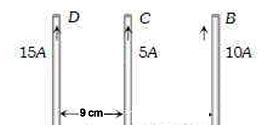
Three long, straight and parallel wires carrying currents are arranged as shown in the figure. The wire C which carries a current of 5.0 amp is so placed that it experiences no force. The distance of wire B from wire D is then :
13.
The direction of line of magnetic field of bar magnet is:
14.
The work done in turning a magnet of magnetic moment 'M' by an angle of $90^{\circ}$ from the meridian is 'n' times the corresponding work done to turn it through an angle of $60^{\circ}$, where 'n' is given by:
15.
A magnet of magnetic moment $50\hat{i} Am^{2}$ is placed along the x-axis in a magnetic field $\vec{B}=(0.5\hat{i}+3.0\hat{j})T$. The torque acting on the magnet is:
16.
In electromagnetic induction, the induced charge in a coil is independent of
17.
The direction of induced current is such that it opposes the very cause that has produced it. This is the law of:
18.
The magnetic flux linked with a coil, in webers, is given by the equations $\phi=3t^{2}+4t+9$ Then the magnitude of induced e.m.f. at $t=2$ second will be:
19.
When a wire loop is rotated in a magnetic field, the direction of induced e.m.f. changes once in each
20.
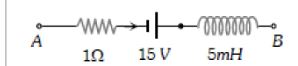
The network shown in the figure is a part of a complete circuit. If at a certain instant the current i is 5 A and is decreasing at the rate of $10^{3}A/s$ then $V_{A}-V_{B}$:
21.
An e.m.f. of 5 volt is produced by a self inductance, when the current changes at a steady rate from 3 A to 2 A in 1 millisecond. The value of self inductance is:
22.
Self induction of a solenoid is :
23.
The number of turns of primary and secondary coils of a transformer are 5 and 10 respectively and the mutual inductance of the transformer is 25 henry. Now the number of turns in the primary and secondary of the transformer are made 10 and 5 respectively. The mutual inductance of the transformer in henry will be :
24.
The ratio of secondary to the primary turns in a transformer is 3: 2. If the power output be P, then the input power neglecting all loses must be equal to:
25.
In an inductor of inductance $L=100~mH$ a current of $I=10A$ is flowing. The energy stored in the inductor is:
26.
In an ac circuit $I=100~\sin~200\pi t.$ The time required for the current to achieve its peak value will be :
27.
The r.m.s. value of an ac of 50 Hz is 10 amp. The time taken by the alternating current in reaching from zero to maximum value and the peak value of current will be:
28.
Current in the circuit is wattless, if
29.
A 10 ohm resistance, 5 mH coil and 10 µF capacitor are joined in series. When a suitable frequency alternating current source is joined to this combination, the circuit resonates. If the resistance is halved, the resonance frequency
30.
A resistance of 300 $\Omega$ and an inductance of $\frac{1}{\pi}$ henry are connected in series to a ac voltage of 20 volts and 200 Hz frequency. The phase angle between the voltage and current is:
31.
In an ac circuit the reactance of a coil is $\sqrt{3}$ times its resistance, the phase difference between the voltage across the coil to the current through the coil will be :
32.
When 100 volt dc is applied across a coil, a current of 1 amp flows through it. When 100 volt ac at 50 cycle $s^{-1}$ is appllied to the same coil, only 0.5 ampere current flows. The impedance of the coil is:
33.
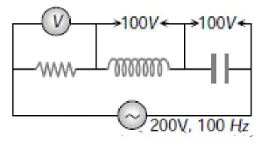
In the circuit given below, what will be the reading of the voltmeter
34.
An inductor of inductance L and resistor of resistance R are joined in series and connected by a source of frequency $\omega$. Power dissipated in the circuit is:
35.
An LCR series circuit with a resistance of 100 ohm is connected to an ac source of 200 V (r.m.s.) and angular frequency $300~rad/s.$ When only the capacitor is removed, the current lags behind the voltage by $60^{\circ}$ When only the inductor is removed the currrent leads the voltage by $60^{\circ}$ The average power dissipated is:
36.
A virtual current of 4A and 50 Hz flows in an ac circuit containing a coil. The power consumed in the coil is 240 W. If the virtual voltage across the coil is 100 V its inductance will be:
37.
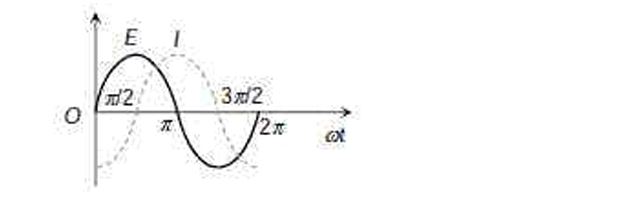
The variation of the instantaneous current (I) and the instantaneous emf (E) in a circuit is as shown in fig. Which of the following statements is correct
38.
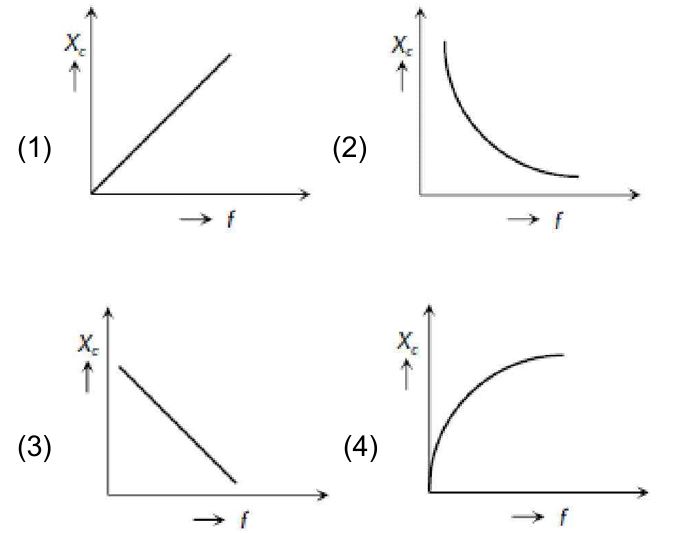
Which of the following curves correctly represents the variation of capacitive reactance $X_{c}$ with frequency f.
39.
Which of the following are not electromagentic waves
40.
Maxwell's equations describe the fundamental laws of :
41.
An electromagnetic wave going through vacuum is described by $E=E_{0}\sin(kx-\omega t);$ $B=B_{0}\sin(kx-\omega t).$ Which of the following equation is true
42.
Electromagnetic waves travel in a medium which has relative permeability 1.3 and relative permittivity 2.14. Then the speed of the electromagnetic wave in the medium will be :
43.
For an ac circuit $V=15\sin\omega t$ and $I=20\cos\omega t$ the average power consumed in this circuit is:
44.
The frequency of an alternating voltage is 50 cycle/sec and its amplitude is 120 V. Then the r.m.s. value of voltage is:
45.
A choke coil has: